Balsa Grain Classification
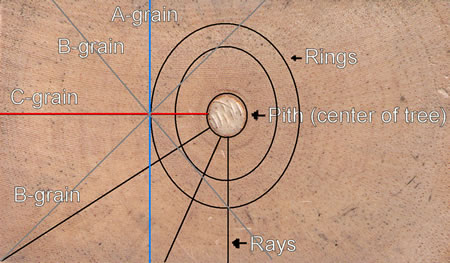
Balsa grows in a circle "tree rings" around a central point called pith (center of the tree). Pith is very weak and squishy like weak foam, bubble gum, or a rice cake. The blocks must be cut around the pith which limits the maximum size of the blocks harvested from the tree. The rings grow in a circle around the pith and determine how quickly the tree has grown. Lines can be seen arrayed directly from the center of the tree and are called rays. These rays are very resistant to flexing and are called C-grain balsa sheets or quarter sawn. They are very brittle but are good for items you don't want to flex. If you cut at a 90 degree angle from the rays the balsa sheet would be called A-grain which is very flexible. The last grain classification is the B-grain classification which has to a small degree both A-grain and C-grain characteristics and is the classification of what the majority of balsa sheets end up. B-grain is cut at a 45 degree angle to both A and C-grain.
A-grain is good for flexing the width of a balsa sheet. It is used for bending around objects or wings on airplanes. Half of all balsa grain sheets end up as B-grain which is an all purpose balsa item. C-grain is good for ultra light airplanes that need to have stiff wings and are not flexed so C-grain allows the wings to keep their shape and be very light. Please note that C-grain is brittle and if flexed it will shatter easily.
All three grain classifications when pressure is applied from the top through the grains will have similar compressive strengths. Just think of a dowel in compression as it always has all three grain classifications by definition and will hold up under compression the same as if you turned it 90 degrees and put it in compression again. Grain classification is mainly used for airplanes.
If balsa is square the grain classification is either A-C grain or B-B grain only. This means with A-C grain the first side and opposite side are A grain and the other two are C-grain or the stick has all four sides as B-grain.
If the stick is rectangle the widest side determines the grain classification which could be A-grain, B-grain, or C-grain.
Dowels do not have a grain classification since they have 2 C-grain sides, 2 A-grain sides, and 4 B-grain sides.
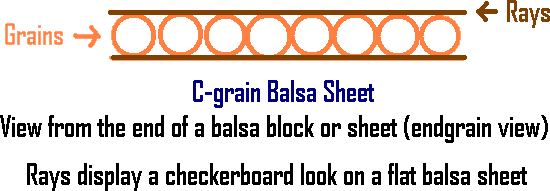
C-grain is similar to pieces of paper with straws in between. Having extra thin segments with tiny straws keeps the section rigid with one "paper section" in compression and the other side in tension. The straws keep the C-grain segment from collapsing when stressed. A-grain does not have the rays to hold it together so it is very flexible.
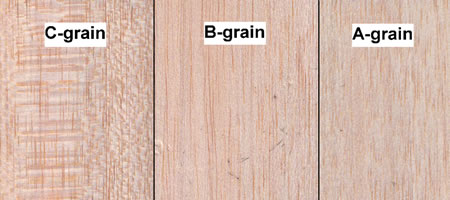
Next is a comparison with A, B, and C-grain side by side. Notice that the C-grain balsa sheet has a distinct checkerboard pattern and that A and B-grain look the same. You have to look at the narrow edge of the balsa sheet to determine whether it is A or B-grain. For A-grain you look at the narrow edge and it will have a checkerboard pattern. B-grain will look the same on the large flat side and the narrow edge.
|








![[+] click to view larger image](i/grain%20classification/balsa_grain_block_ring_rays_abc_grain3_lg.jpg)
![[+] click to view larger image](i/grain%20classification/grain_comparison3_lg.jpg)